
naciri_a
Book: Traité de gouvernance corporative, théories et pratiques à travers le monde, 2006. Les presses de l’Université Laval
http://www.amazon.fr/Trait%C3%A9-gouvernance-corporative-Th%C3%A9oriespratiques/dp/2763782892
Les crises financières de la fin du vingtième siècle – la crise asiatique et, un peu plus tard, la série noire des scandales corporatifs – nous ont confirmé que certaines organisations se sont laissées aller à la manipulation des comptes et quelquefois carrément à la fraude. Même si les économies occidentales sont très souvent l’objet de ces controverses, d’autres ne sont pas pour autant écartées du problème et encore aujourd’hui les différents intervenants – administrateurs, hauts dirigeants, vérificateurs, analystes financiers et législateurs – font les frais de la crise de confiance qui a résulté de ces situations. Les investisseurs et les citoyens doutent de la capacité des dirigeants à garantir la disponibilité d’une information fiable et pertinente sur la santé financière des organisations. En conséquence, partout dans le monde, les législateurs en sont arrivés à la nécessité de reconsidérer certains processus de gouvernance corporative
Book: Comparative Governance around the world, 2008. Routlege Francis Taylor Publisher, London, New York
http://www.amazon.com/Corporate-Governance-Around-Routledge-Studies/dp/0415428742
The last Asian financial crisis, coupled with the western series of corporate scandals, has caused investors and citizens to doubt mangers’ ability to guarantee credible financial information about organizations. Consequently, legislators all over the world have come to realise the necessity of legislating in the area of corporate governance.
This book explores several national corporate governance reform experiences from around the world (including Canada, China, the United States, and the European Union) and offers an explanatory theory with regard to national systems of corporate governance. It also underlines corporate governance as a management tool and principle. The author argues that each country should be encouraged to build its own system of corporate governance which should be harmonized with its history, culture and the level of its economic development.
Book: Traité de gouvernance d’entreprise, instrument de création de la richesse, 2015.
https://www.puq.ca/catalogue/themes/traite-gouvernance-entreprise-edition-2834.html
L’éthique en affaires peut-elle l’emporter sur la soif du gain ? Depuis la publication de la première édition du présent ouvrage, de plus en plus d’organisations possèdent en effet leur propre code de gouvernance qu’elles rendent public. Mais la gouvernance n’est pas qu’un simple exercice de préparation de documents, elle est surtout une question de conviction et d’attitude : la conviction que la manière la plus payante de faire des affaires à long terme est de respecter les règles de confiance et d’éthique ; et l’attitude qui consiste à accepter de traduire les principes de gouvernance en règles de gestion.
Book: Credit rating Governance, The gatekeepers, 2015. Routlege Francis Taylor Publisher, Cambridge, UK
https://www.routledge.com/Credit-Rating-Governance-Global-Credit-Gatekeepers-1st-Edition/Naciri/p/book/9781315757834
Credit rating agencies play an essential role in the modern financial system and are relied on by creditors and investors on the market. In the recent financial crisis, their power and reliability were often questioned, yet a simple rating downgrade could threaten to bankrupt a whole country.
This book examines the governance of credit rating agencies, as expressed by their ability to fairly, ethically and consistently assign higher rates to issuers having lesser default risks. However, factors such as the drive for increased revenue and market share, the inadequate business model, the inadequate methodology of assessing risk, opacity and inadequate internal monitoring have all been identified as critical governance failures for credit agencies. This book explores these issues, and proposes some potential solutions and improvements
Book: Sovereign Credit Rating: Questionable Methodologies, May 22 2017
The current degradation of sovereign balance sheets raises very real concerns about how sovereign creditworthiness is measured by credit rating agencies. Given the disastrous economic and social effects of any downgrade, the book offers an alternative and calls for more transparency about the quantitative measures used in calibrating the rating process and how sovereign ratings are validated. It argues that oversight is required and procedures improved, including subjecting methodologies of assessing default to more standardization and monitoring.
https://www.amazon.ca/Sovereign-Credit-Rating-Questionable-sMethodologies/dp/1138678546.
Book: The Governance Structures of the Bretton Woods Financial Institutions, A Case of « Beggar-Thy-Neighbour », December 2018
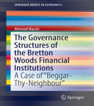
This book uses institutional data to examine and analyze the current governance structures of Multilateral Financial Institutions (MFIs) with the ultimate goal of reforming MFI governance models to be more responsive to the needs of developing countries. Founded in the post-World War II era, MFIs, collectively known as the Bretton Woods Financial Institutions (BWFIs), were created to promote global economic development and financial stability. This book argues, however, that the governance structures and policies of the MFIs have been biased in favour of developed country members, excluding less economically advanced countries from decision-making processes and perpetuating the economic status quo. Considering the inability of MFIs to adequately respond to the financial needs of developing countries, the book raises an alternative proposal for BWFI reform, based on the following criteria: (i) encouraging development incentives, (ii) favouring development learning through knowledge transfer and easing its appropriation by developing countries, and (iii) guiding and facilitating access to private international financial markets. Combining historical economic analysis with policy recommendations for the future, this book will be of particular interest to students and researchers of development economics, governance, and MFIs, as well as practitioners working with the institutions studied.
The wealth of nations and economic governance, international evidence, 2020
The paper suggests that wealth maximization and sustainability model (WMS) conforms to the basic maximization rule advocated by finance theory and they can therefore be dealt with within the same theoretical framework. A nation can develop and create wealth to the maximum of its potential only when it efficiently manages its development, i.e. when it observes the rule of national wealth maximization. Wealth is increasing unevenly around the world, as is the quality of living conditions. This prompts the following questions: What drives wealth maximization and sustainability (WMS), and how can it be made to last? To answer these two questions the paper suspects economhc governance to impact tremendously wealth creation and accumulation, and tests its effect using a sample of 40 rich countries for the year 2019. It reveals important findings that make it possible to sketch a model of wealth maximization and sustainability.